Swiss Identity Verification

Instant & Deepfake-resistant Swiss-grade Privacy & Confidentiality

Executive Overview & Technical Whitepaper

Version: 1.0 · Date: December 2025 · Target: Investors & Strategic Partners
Swiss Privacy Commitment

Swiss Identity Verification is developed to meet Switzerland’s standards of privacy, consent, and minimal user-data exposure. All collected biometric and identity information is protected using Swiss-grade encryption and user-controlled data lifecycle principles.

Continuous Scene Verification™ (CSV)

The Future of Fast, Deepfake-Resistant ID Verification

Executive Summary

Swiss Identity Verification is our next-generation identity verification platform, powered by our proprietary technology, Continuous Scene Verification CSV. CSV verifies the user’s face and ID document while analyzing the environment (the physical consistency of the scene) — all within a single continuous 2-second video. This novel, scene-level analysis of face, ID, and environment delivers a faster and smoother onboarding experience with industry-leading deepfake resistance.

Today, customers abandon onboarding and KYC flows because they are forced to capture perfect document photos and perform awkward liveness actions like blinking, smiling, or turning their heads. At the same time, deepfake-driven fraud is accelerating faster than traditional identity verification systems can evolve.

To reduce friction, many providers have shifted from active liveness (blink, turn, smile) to passive or semi-active liveness, where the system attempts to detect real presence without explicit user actions. While this improves user experience, it still requires separate document photos, introduces delays, and remains vulnerable to evolving deepfake attacks.

Our technology – Continuous Scene Verification (CSV) – solves these problems by verifying the user’s face and ID while checking that lighting, shadows, and motion behave consistently across the face, hands, and ID, confirming they exist in the same real physical scene – all within a short 2-second video clip where the user simply brings their ID next to their face. No photo uploads, no switching steps, no instructions, and no gestures such as blinking or head-turning. CSV represents the evolution beyond passive liveness, collapsing liveness, document capture, and scene analysis into one seamless step and delivering industry-leading resistance to deepfake attacks: today, no AI can simultaneously forge a live face, real ID motion and hologram physics, hand and its motion, face–hand–ID motion geometry consistency, physical occlusion behavior (when the ID partially covers the face) and lighting/shadow consistency across face, ID, hands, and surrounding scene in real time.

This creates:

Faster identity verification experience

Higher deepfake resilience (i.e. materially reduced fraud)

Higher conversion rates for our clients

CSV is the next-generation identity verification layer that replaces the document photo, selfie, and liveness steps inside any KYC or onboarding flow — modernizing decade-old legacy processes with a frictionless, deepfake-resilient standard.
Market Problem

The identity verification industry faces two compound failures:

1.1 Identity Verification Is Too Slow and Complicated

The most painful part of any KYC process is the identity verification step, where users must:

• Upload ID photos

• Take a selfie

• Perform liveness actions (blink, smile, turn head)

• Re-take images due to glare, blur, or incorrect framing

• Navigate multiple screens and repeated capture attempts

This outdated multi-step identity verification flow increases time, cost, and failure points, causing high abandonment rates — the single strongest cause of lost revenue in fintech onboarding funnels.

1.2 Deepfakes Have Overtaken Legacy Identity Verification Methods

Deepfake technologies can now simulate:

• Blinking

• Head movement

• Facial expressions

• Mouth articulation

This means traditional active liveness checks in identity verification are increasingly ineffective. Even passive liveness methods, which the market is shifting toward, are not fundamentally safe – deepfakes are constantly evolving to mimic these signals, turning liveness into a never-ending arms race


Market Size & Opportunity

The identity verification (IDV) market is already large and expanding quickly.

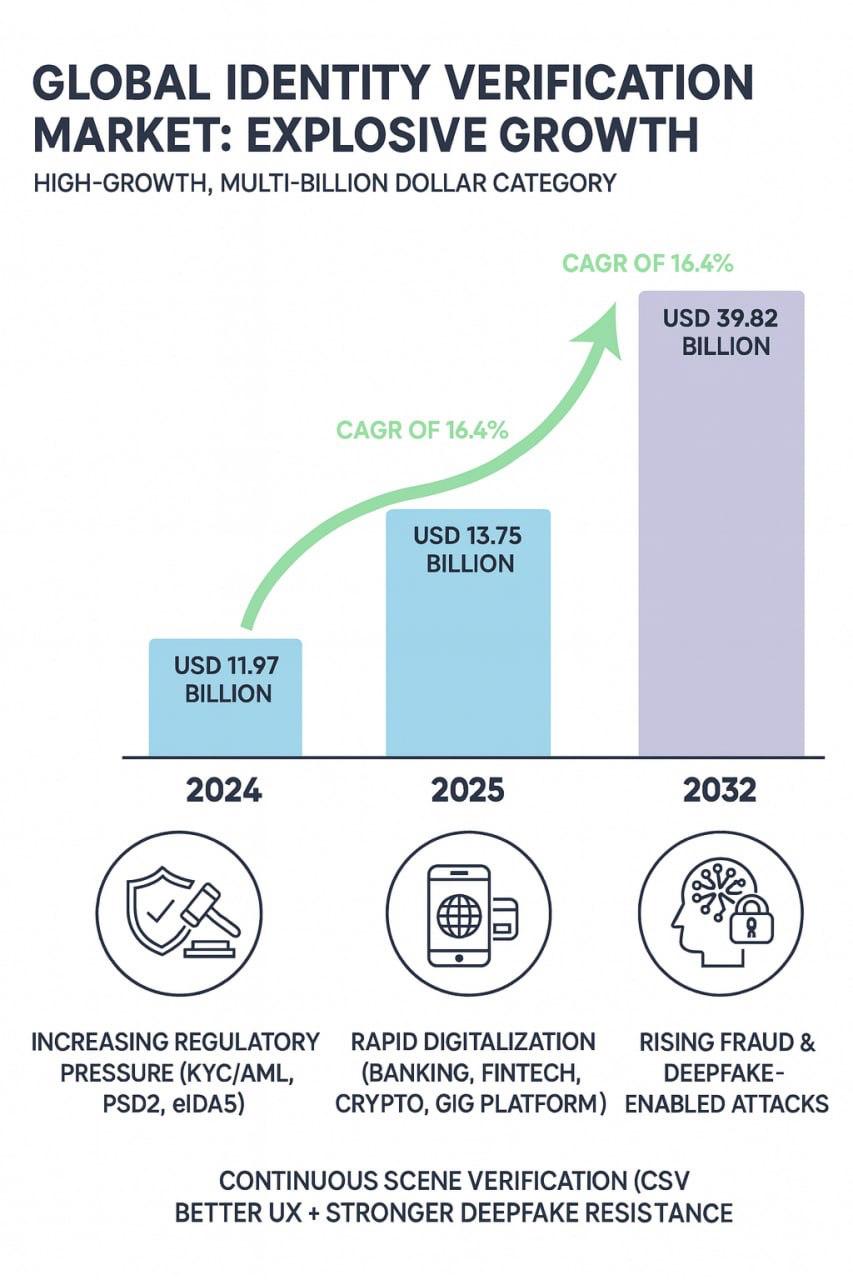
According to Fortune Business Insights, the global identity verification market was valued at USD 11.97 billion in 2024. It is projected to grow from USD 13.75 billion in 2025 to USD 39.82 billion by 2032, representing a CAGR of 16.4% over the forecast period.

This growth is driven by:

• Increasing regulatory pressure (KYC/AML, PSD2, eIDAS, etc.)

• Rapid digitalization of banking, fintech, crypto, and gig platforms

• Rising fraud and deepfake-enabled attacks, which push enterprises to adopt stronger IDV

In other words, IDV is a high-growth, multi-billion dollar category where better UX and stronger deepfake resistance can capture meaningful market share. Continuous Scene Verification (CSV) is designed to sit exactly at this intersection.

global identity verification market

Our Solution: Continuous Scene Verification™ (CSV)

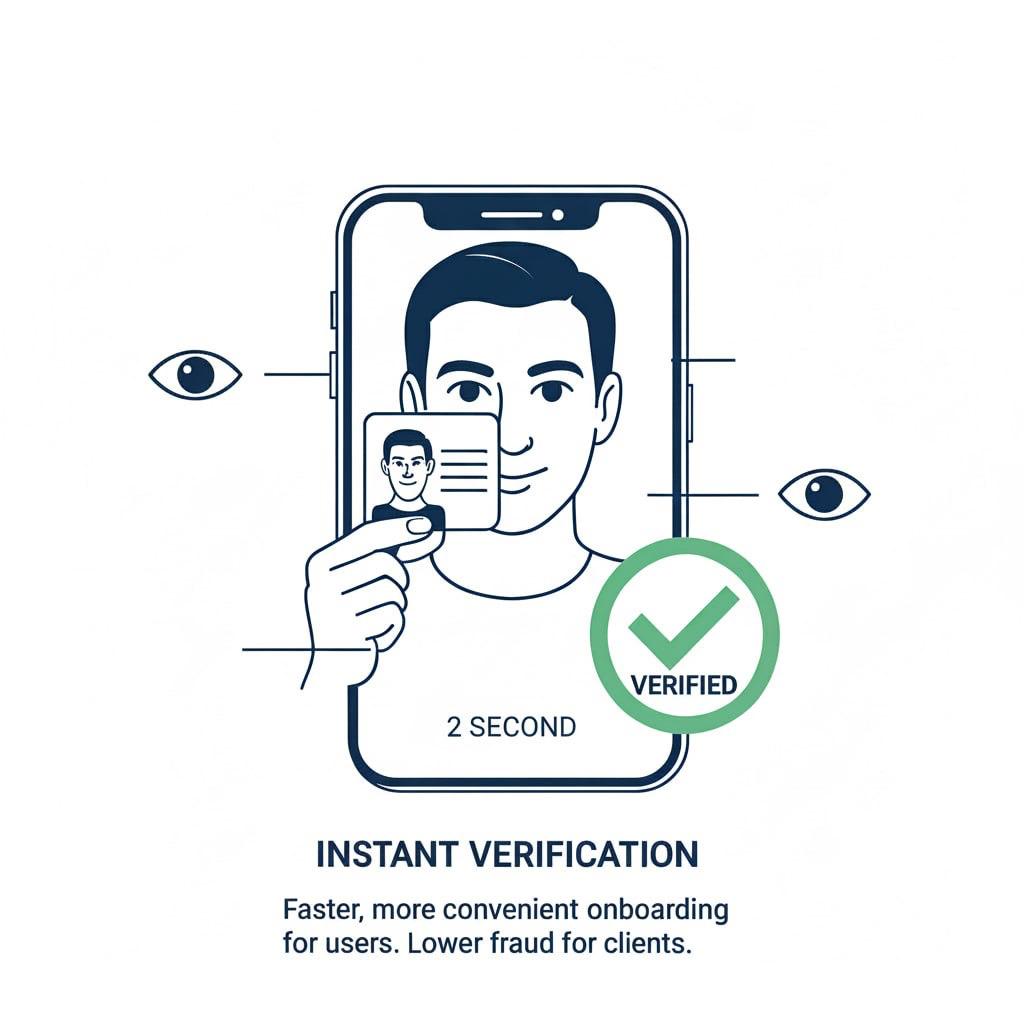
A single 2-second video replaces the entire old identity verification step inside KYC.

The user simply:

1. Looks at the camera

2. Brings their ID into the frame

That's it.

CSV analyzes the face, the ID, and the surrounding environment together in one continuous video stream.

instant verification

Why CSV Is a Breakthrough

3.1 frictionless User Experience

CSV enables fast and frictionless verification:

• No document photo

• No switching camera

• No blinking or head-turning

• No long instructions

• No retakes

This dramatically increases user completion rates.

3.2 Stronger Fraud Defense

A deepfake can imitate a face.

A fake ID can imitate a document.

But no AI today can forge a live face + real ID motion and hologram physics + human hand & its motion Face–hand–ID motion geometry consistency + lighting consistency (across face, Id, hand, and surrounding scene) all at once in real time.

CSV’s multi-entity verification provides fraud signals impossible in traditional flows:

• Shared environmental lighting

The system checks that shadows, reflections, and color temperature match across the face, hands, ID and the surrounding scene revealing any synthetic or composited elements.

Physical occlusion behavior when the ID overlaps the face

Real-world occlusion and shadowing occur when the ID partially covers the face— conditions under which deepfake overlays break, flicker, or distort.

Face–hand–ID geometry consistency

CSV verifies that the face, hands, and ID exist in a coherent 3D structure with realistic spatial relationships that deepfakes cannot replicate.

Real hologram (placed on the ID document) behavior

CSV analyzes dynamic hologram responses to movement and light, which cannot be reproduced by printed, screen-based, or AI-generated forgeries.

Motion-based authenticity of the ID

Subtle bending, rotation, and glare patterns of a real ID in motion expose tampered, static, or digitally inserted documents.

Micro-movement synchronization

The solution tracks tiny, involuntary human movements and verifies that the face, hands, and ID respond in a physically consistent manner.

Depth cues and parallax

Movement of the camera or subject creates layered motion at different depths, which is impossible to fake accurately in 2D deepfake outputs.

Document–face identity linkage

CSV verifies that the face in the frame and the identity printed on the ID correspond through biometric matching, temporal consistency, and physical interaction — preventing attackers from pairing a real ID with a fake or deepfaked face, a common weakness in traditional liveness checks and separate ID-photo flows.

This creates a next-generation moat:

You cannot beat CSV without simulating an entire physical environment in real-time — beyond current AI capabilities.

3.3 Lower Infrastructure Cost

CSV processes a single stream, not three separate assets (selfie, video, ID picture). This reduces:

• storage costs

• compute costs

• transmission overhead

And enables true real-time verification.


Competitive Landscape and Differentiation

4.1 Identity Verification (IDV) Competitors

ID verification providers still rely on:

• Multi-step onboarding flows

• Separate ID photo capture

• Semi-active liveness steps

• Limited deepfake defense

Provider Capture Flow Liveness Style Deepfake / Scene Defense UX Friction
Swiss Identity Verification – CSV Single video with face + ID environment in one shot Scene-level passive liveness (face, ID, hands, surrounding scene, lighting, shadows, motion analyzed together) Very high: scene-level defense – must fake face, physical ID (incl. hologram behavior), hands, consistent lighting/shadows ( between face, ID, hands and surrounding scene), and correct physical occlusion when the ID overlaps the face in one continuous clip Very low: one short, gesture free step
Onfido (Entrust) Separate ID upload + selfie / video Mainly passive face liveness + simple head-turn (Motion) Medium–high: strong selfie and spoof detection, but ID is verified separately and there is **no explicit scene-level check of shared lighting/shadows or occlusion between face and ID. Medium – two main steps plus motion prompt
Veriff ID photo + selfie / video; sometimes scripted sequence Mainly passive facial liveness with occasional user actions Medium–high: good video forensics, but ID and face are checked in sequence and the system does not enforce full scene/lighting or occlusion consistency across face, ID, hands, and environment Medium – fast but still guided multi step
Jumio ID scan + selfie (photo or short video) Passive face liveness (no explicit gestures) Medium–high: strong face and document anti spoofing, but defenses are primarily face centric; there is no joint physics check tying shadows, motion, or occlusion (ID partially covering face) across the scene Medium – at least two distinct capture steps
IDnow (AutoIdent / VideoIdent) AutoIdent: ID video + selfie video; VideoIdent: live agent call Mix of passive/active; agents may request gestures High when human supervised (VideoIdent); medium in automated flows, where ID and face are still separate stages and environmental / physical consistency (lighting, shadows, occlusion) is not systematically enforced by AI High – multi minute calls or multi video flow

Competing vendors isolate liveness from document validation and don't analyze the full physical scene in a single continuous flow.

4.2 Market Direction and the Gap

The market is slowly shifting toward passive liveness, because it reduces friction and avoids user instructions.

But the core limitations of legacy ID verification remain:

• Users must still take a separate document photo

• Liveness and document checks are performed independently

• Deepfake resistance remains medium at best

• High-risk flows still require active steps, hurting UX

This shows the industry is stuck in a hybrid, outdated model.

The next logical evolutionary step is to merge:

liveness

document validation

environment understanding

into a single continuous capture. That is exactly what CSV enables.

4.3 Evolution of Liveness Approaches

Feature Active Liveness (with separate document check) Passive Liveness (with separate document check) CSV (Our Model)
User friction High Low Very low
Works against deepfakes Weak Medium/High Extremely high
Scene/environment analysis No Limited Full scene
Document + face linkage No No Yes
Temporal consistency Weak Weak Strong
Attack difficulty Low Medium Extremely high
UX Bad Good Excellent
Natural physical interaction (ID-as-liveness) No No Yes
Number of combined signals for verifiction single a few multiple, rich

CSV is the evolution after passive — not a new variant of liveness, but a new verification paradigm that merges identity, liveness, and scene physics.


Technology Overview (High-Level for Investors)

CSV combines 4 engines:

5.1 Passive Liveness Engine

Detects life using:

• micro-movements

• skin reflectance

• depth cues

• optical flow

No user action needed.

5.2 Document Authenticity Engine

Analyzes ID within the video (ID liveness check):

• hologram behavior

• glare movement

• bending and parallax

• typography and MRZ structure

• real-time motion artifacts

These physical signals are impossible to fake with a static photo.

5.3 Deepfake Detection Engine

Detects:

• occlusion inconsistencies when ID overlaps face ( breakthrough for Deepfake detection)

• GAN artifacts

• face-mask boundary inconsistencies

• temporal coherence breaks

• lighting mismatches

5.4 Environment Consistency Engine

Cross-consistency checks

(core breakthrough for detecting environmental inconsistences on face, ID and hand):

• shadows

• light direction

• color temperature

• hand–face photometric coherence

5.5 Fraud Fusion Model

All scores are combined to output:

• pass/fail

• confidence score

• reason codes

• fraud type (deepfake, fake ID, replay, etc.)


Regulatory & Compliance Considerations

Swiss Identity Verification delivers the identity verification layer used within onboarding, KYC, and compliance workflows across financial institutions, fintech platforms, and regulated service providers. Because Swiss Identity Verification processes biometric and identity data, the platform must adhere to all applicable GDPR requirements, including:

Data minimization — collecting only the information strictly required for identity verification.

Privacy by design & by default — embedding privacy safeguards directly into system architecture.

Lawful basis for processing — typically legitimate interest or explicit consent, depending on integration.

Transparency — informing users about data collection, use, retention, and data sharing policies.

Security measures — encryption, strict access controls, audit logging, and secure deletion procedures.

To strengthen security, trust, and interoperability, Swiss Identity Verification is designed to align with the following industry standards and frameworks:

ISO/IEC 27001 — information security management best practices.

SOC 2 Type II — operational and security assurance for enterprise environments.

ISO/IEC 30107-3 Presentation Attack Detection PAD — the global standard for anti spoofing and liveness security.

iBeta PAD Level 1-3 certification — independent laboratory testing that validates resistance to real-world presentation attacks, including printed photos, screens, masks, and deepfake replays.

eIDAS interoperability — ensuring compatibility with European digital identity ecosystems, including national eID schemes and the emerging EUDI Wallet, enabling verification layer to bind digital identities to real live users.

NIS2 alignment — supporting clients operating in sectors covered by the EU cybersecurity directive.

Swiss Identity Verification focuses on delivering deepfake-resistant, real-time identity verification that can be integrated seamlessly into broader KYC, onboarding, or compliance workflows, enabling regulated institutions to make confident identity decisions with significantly reduced risk.


Business Impact for Clients & Defensibility

7.1 Increase Conversion

Fewer steps → fewer drop-offs

Faster flow → more users onboarded

Better UX higher brand trust

CSV improves the most painful part of the onboarding funnel — identity verification — leading to a projected 20-40% increase in overall KYC completion rate.

7.2 Reduce Fraud

CSV catches:

• Deepfakes

• Fake IDs

• Printed attacks

• Screen replays

• Injection attacks

By analyzing face, ID, and environment simultaneously, CSV materially reduces fraud within the identity verification layer of the onboarding process.

7.3 Reduce Identity Verification Costs

CSV replaces three separate assets (ID photo, selfie, liveness video) with one continuous capture, which reduces:

• Infrastructure and storage

• Manual review volume

• Support tickets related to identity verification

• User retries and abandonment

• Time-to-verify

This produces lower cost per verification and faster onboarding times.

7.4 Defensibility

CSV is defensible because it changes the structure of identity verification from a multi-step sequence into a single continuous capture. Clients redesign onboarding around CSV, retrain their fraud models using CSV’s unique scene-level signals, and integrate CSV deeply into risk, compliance, and product flows. Replacing CSV would require redesigning UX, reconfiguring fraud systems, and accepting lower conversion and higher fraud — creating naturally high switching costs


Market Fit & Team & Vision

CSV establishes a new global standard for identity verification — fast, effortless, and resistant to AI-driven fraud.

8.1 Market Fit Today

CSV is an immediate fit for sectors where onboarding speed and fraud control determine growth, including the financial sector as well as gig-economy platforms, high-risk marketplaces, mobility and travel services and remote hiring workflows. These industries depend on frictionless onboarding and strong fraud resistance to compete.

8.2 Team

Swiss Identity Verification is being developed by a team of security software engineers and AI computer vision specialists with a proven track record in high-security systems — from Zero-Trust cloud infrastructure and end-to-end encrypted communication to face detection and recognition systems.

8.2 Long-Term Vision

• Become the core identity verification layer for web and mobile onboarding

• Enable users to prove identity in seconds, anywhere online

• Serve as the foundational identity infrastructure across the emerging digital identity ecosystem

CSV is designed to become the invisible infrastructure behind every seamless onboarding experience.

Not an Incremental Improvement — a Paradigm Shift

CSV does not refine the old selfie → liveness → document upload sequence.

It replaces it with a single continuous and AI-driven fraud resilient 2-second capture.

As deepfake fraud accelerates and user expectations evolve, the market requires technology that is simultaneously:

dramatically harder for attackers

and easier for users

CSV delivers both.

Final Statement

Fast, intuitive, highly defensible, and engineered for the deepfakes and AI-driven fraud era.

CSV defines the next decade of identity verification.